
Why Is It Critical in Industrial Embedded Software?
In embedded software projects, hardware control is often reduced to writing registers or enabling peripherals. While this approach may work for small or experimental projects, it quickly becomes insufficient for industrial-grade, long-life, and scalable systems.
This is where the Board Support Package (BSP) becomes a foundational element of professional embedded software architecture.
A BSP establishes a controlled, standardized, and maintainable interface between application software and hardware.
A BSP is not merely a collection of low-level drivers. Its primary objectives are:
- Centralizing hardware access
- Standardizing software architecture
- Isolating hardware dependencies in a controlled way
- Improving long-term maintainability and extensibility
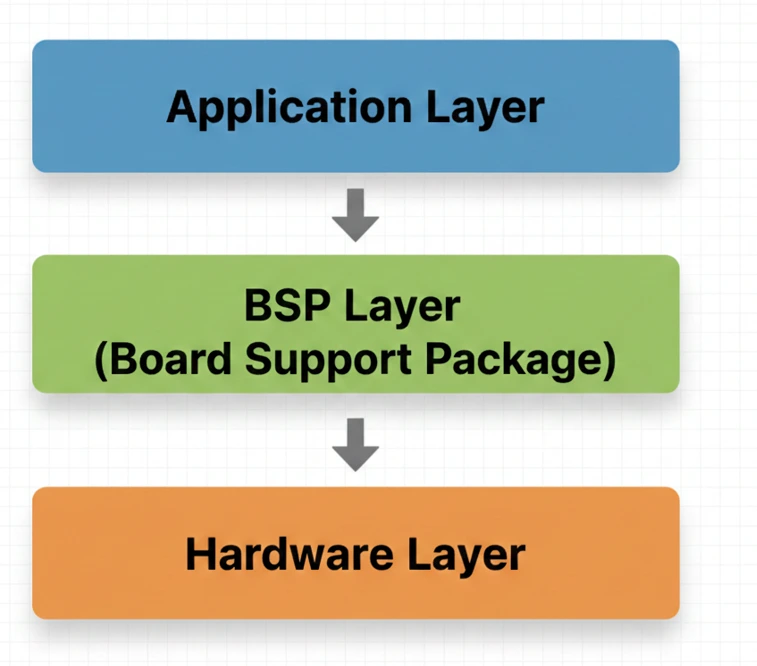
Why BSP Is More Than Just a Driver Layer
This level of structure and discipline does not emerge naturally from using vendor libraries or example projects.
Designing a professional BSP requires a deliberate architectural approach, practical experience, and a clear understanding of how hardware abstraction should scale across different microcontrollers and projects.
The Embedya BSP Development Training is built around this exact perspective.
Rather than focusing on register-level programming or vendor-specific implementation details, the training emphasizes BSP architecture, API design principles, and reusable design patterns that can be applied consistently across different MCU families.
Through hands-on exercises and real-world scenarios, participants learn how to design, evaluate, and evolve BSPs as a professional software discipline.
If you want to truly master BSP as a professional discipline rather than a collection of drivers, this training provides structured and practical learning rooted in real industrial cases.
Key Advantages of Using BSP
1. Builds Corporate Software Heritage
BSP transforms hardware knowledge from individual developers into a structured and reusable corporate asset.
As a result:
- New developers onboard faster
- Knowledge loss is minimized
- Software systems remain sustainable over years
2. Provides a Clear Guide for New MCU Integrations
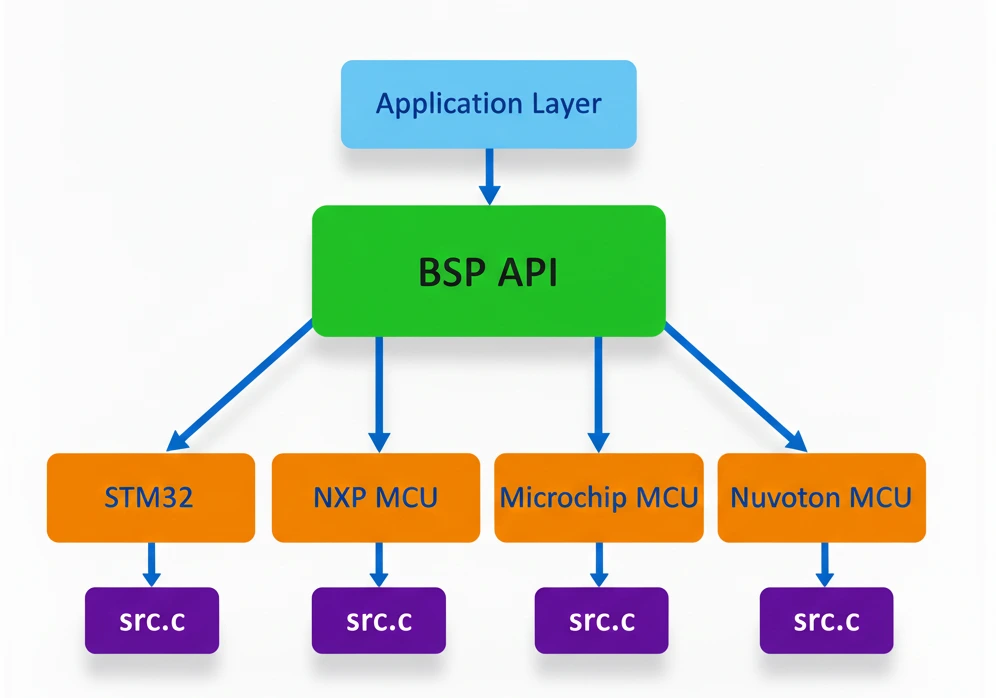
When migrating to a new microcontroller, BSP provides a clear and repeatable roadmap:
- The API remains unchanged
- Only MCU-specific source files are rewritten
This enables the same application logic to run across multiple MCU platforms without architectural changes.
3. Reduces MCU Dependency
With BSP abstraction:
- Projects are not locked to a single MCU vendor
- Supply-chain or cost-related changes are easier to manage
- Alternative MCU options remain technically viable
This flexibility represents a strategic advantage for industrial and commercial products.
4. Standardizes Test Scenarios
Thanks to fixed and stable APIs:
- Test scenarios become repeatable
- Automated testing frameworks are easier to implement
- Regression testing becomes meaningful
Same API means same behavior, independent of the underlying hardware.
5. Improves Extensibility and Maintainability
Adding new hardware features becomes controlled and predictable:
- New GPIOs
- Additional UARTs
- Extra Timers or ADC channels
In a well-designed BSP, such extensions typically require:
- Adding a new identifier in the header file
- Registering a new configuration instance in the source file
The application layer remains untouched, ensuring minimal risk and high confidence during system evolution.
BSP and Software Architecture
BSP enables proper software architecture principles:
- Layered design
- Separation of concerns
- Clear boundaries between hardware-dependent and hardware-independent code
Without BSP, maintaining these principles at scale is nearly impossible.
A well-structured BSP provides a stable foundation for middleware, services, and application layers.
Debugging and Maintenance Benefits
Centralized hardware control allows:
- Faster fault isolation
- Predictable system behavior
- Reduced debugging time
These benefits are especially valuable for field-deployed and long-life products, where maintenance cost directly impacts product success.
Embedya’s BSP Development Approach
Embedya’s BSP Development Training is designed to transfer these principles through:
- Real industrial use cases
- Hands-on hardware sessions
- Live debugging and architectural walkthroughs
The training focuses not only on how BSP is implemented, but more importantly on why it must be designed this way.
Conclusion
BSP is a strategic foundation, not an implementation detail.
It delivers:
- Quality
- Portability
- Sustainability
- Corporate software knowledge
While BSP may require additional effort at the beginning, the long-term cost of embedded projects developed without BSP is always higher.